
|
Dr. Stefanie Demirci 

|
Biography
I am an experienced scientists with a demonstrated history of working in research industry and academia. I hold a PhD in Informatics (Computer assisted medical procedures) from Technical University of Munich (TUM). I have initiated and managed numerous research and training collaborations at national and international level. Furthermore, I have been instrumental in the organization and prosperous execution of numerous national and international high-level scientific events including management of technical infrastructure, editorial activities and outreaching communications. As of October 2018, I am a Scientific Consultant at VDI/VDE Innovation und Technik GmbH.- 04/2011-09/2018: Senior Researcher and Research Manager at CAMP, TUM
- 11/2010-03/2011: Postdoctoral Research Fellow at SINTEF Medical Technology in Trondheim, Norway (MILab Postdoctoral Fellowship)
- 11/2006-10/2010: PhD at CAMP, TUM
- 10/2000-07/2006: Informatik (Major) and Medizinische Informatik (Minor) at Universität Passau
- 04/2005-01/2006: Student Trainee at Siemens Corporate Technology in München
- 10/2003-02/2004: Student Assistant at Universität Passau, Chair for Computer Organization
- 02/2004-12/2004: Study Abroad Student (Master of Information Technology) at University of Sydney in Australia
- 03/2004-09/2004: Research Assistant in Peter Eades' group at National ICT Australia
- Diploma Thesis: A comparison of discriminant analysis methods for optimizing high-dimensional feature spaces (in collaboration with Siemens Corporate Technology)
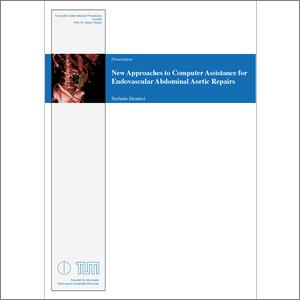
- Dissertation: New Approaches to Computer Assistance for Endovascular Abdominal Aortic Repair (download link)
Research Interests
- Interventional image registration
- Disocclusion in medical images
- Medical device detection/navigation
- Segmentation in medical treatment planning
- Knowledge-based biomedical image analysis
- Biomedical crowdsourcing
Teaching
- WS 2006/07: Tutor for Grundlagen: Betriebssysteme und Systemsoftware (G2)
- SS 2007: Bildverarbeitung und Computergraphik mit C++
- WS 2007/08: Computer Aided Medcial Procedures 1
- SS 2008: Computer Aided Medcial Procedures 2, Hauptseminar Evolving Contours for Medical Image Analysis
- WS 2011/12: Hauptseminar Tracking and Navigation for Computer Aided Surgery
- SS 2013: Hauptseminar New Methods for Computer Assisted Stenting
- WS 2013/14: Interventional Imaging and Image Processing
- SS 2014: Proseminar Image Guided Interventions
- WS2014/15: Interventional Imaging and Image Processing
- WS2015/16: Interventional Imaging and Image Processing
- WS2015/16: Advanced Seminar Course on Computational Biomechanics and Related Inverse Problems
- SS2017: Algorithmen und Datenstrukturen für ET/IT
- WS2017/18: Interventional Imaging and Image Processing
- SS2018: Algorithmen und Datenstrukturen für ET/IT
Professional Activity
Editorial
- Associate Editor of Medical Physics
- Guest Editor of Computerized Medical Imaging and Graphics - Special Issue STENT
- Guest Editor of Computerized Medical Imaging and Graphics - Special Issue on Computation and Visualization for Intravascular Imaging
Reviewing
- Journals: Medical Image Analysis, Medical Physics, Cardiovascular Imaging, IEEE Transactions on Medical Imaging, International Journal of CARS, Physics in Medicine and Biology, Computers in Medicine and Biology, Annals of Biomedical Engineering, European Radiology
- Conferences & Workshops: MICCAI, CVPR, ICCV, ECCV, ISBI, ICIP, MEDICON, ACCV, IPCAI, IPMI
Conferences & Workshops
- Program Committee Member for MICCAI 2017, MICCAI 2018
- Program Committee Member for IPCAI 2017, IPCAI 2018
- MICCAI 2015 Sponsorship Chair
- General Chair of MICCAI-CVII 2011, MICCAI-STENT 2012, MICCAI-STENT 2013, Joint MICCAI-Workshop CVII-STENT 2014, Joint MICCAI-Workshop CVII-STENT 2015, MICCAI-Workshop CVII-STENT 2016, BVM Workshop 2018
- Session Chair at MEDICON 2013, MICCAI 2015, MICCAI 2018
- Local Organization Chair for IPCAI 2011
- Executive Committee Member for IPCAI 2012
Invited Talks
- Pattern Recognition Symposium 2016: Computer Assisted Stenting & Beyond
- 92. Jahrestagung der Vereinigung der Bayerischen Chirurgen e.V.: Neue Perspektiven in der C-Bogen-Positionierung
- 1st Conference on Image-Guided Interventions: Computer-assisted Stenting and Endovascular Navigation
- 30th Annual Congress of the German Vascular Surgery and Medicine Association:
- 3rd Munich Aortic & Carotid Conference: Current Research on Computer Assisted Stenting
- ESF EMRC Exploratory Workshop on Image-guided Laparoscopic Therapies: Interventional Navigation - Calibration, Registration, Validation
Publications
Dissertation
|
S. Demirci New Approaches to Computer Assistance for Endovascular Abdominal Aortic Repairs Technische Universtät München, 2011 (bib) Abstract: This work presents new approaches to computer assistance for endovascular abdominal aortic repairs. In the current clinical workflow there is no technical guidance during the intervention except for two dimensional X-Ray images. Here, we introduce interventional registration methods that are able to handle such occlusions and further image dissimilarities. Thereby, contrast removal and disocclusion techniques are integrated within an image registration procedure. Furthermore, we show for the first time that a detection of the stent graft in the interventional image and a three dimensional recovery of its shape can be obtained at the same time. This allows image-based tracking of the prosthesis and simultaneous visualization within a volume rendering of the patient scan. All introduced methods are completely image based and do not require additional equipment to be introduced into the intervention room. |
Books
|
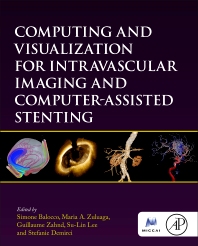
Computing and Visualization for Intravascular Imaging and Computer-Assisted Stenting Editors: Simone Balocco, Maria Zuluaga, Guillaume Zahnd, Su-Lin Lee, Stefanie Demirci Hardcover ISBN: 9780128110188 eBook ISBN: 9780128110195 Imprint: Academic Press Published Date: 5th December 2016 |

|
Intravascular Imaging and Computer Assisted Stenting, and Large-Scale Annotation of Biomedical Data and Expert Label Synthesis Editors: Cardoso, J., Arbel, T., Lee, S.-L., Cheplygina, V., Balocco, S., Mateus, D., Zahnd, G., Maier-Hein, L., Demirci, S., Granger, E., Duong, L., Carbonneau, M.-A., Albarqouni, S., Carneiro, G. Softcover ISBN: 978-3-319-67533-6 eBook ISBN: 978-3-319-67534-3 Imprint: Springer International Publishing Published Date: 2017 |

|
Intravascular Imaging and Computer Assisted Stenting and Large-Scale Annotation of Biomedical Data and Expert Label Synthesis Editors: Stoyanov, D., Taylor, Z., Balocco, S., Sznitman, R., Martel, A., Maier-Hein, L., Duong, L., Zahnd, G., Demirci, S., Albarqouni, S., Lee, S.-L., Moriconi, S., Cheplygina, V., Mateus, D., Trucco, E., Granger, E., Jannin, P. Softcover ISBN 978-3-030-01363-9 eBook ISBN 978-3-030-01364-6 Imprint: Springer International Publishing Published Date: 2018 |
Articles
This list is not maintained anymore. For an updated list of publications, please visit my Google Scholar profile.| 2018 | |

|
L. Casas, N. Navab, S. Demirci
Patient 3D body pose estimation from pressure imaging International Journal of Computer Assisted Radiology and Surgery, https://doi.org/10.1007/s11548-018-1895-3 (bib) |
| D. Stoyanov, R. Taylor, S. Balocco, R. Sznitman, A. Martel, L. Maier-Hein, L. Duong, G. Zahnd, S. Demirci, S. Albarqouni, J. Lee, S. Moriconi, V. Cheplygina, D. Mateus, E. Trucco, E. Granger, P. Jannin
Intravascular Imaging and Computer Assisted Stenting and Large-Scale Annotation of Biomedical Data and Expert Label Synthesis MICCAI 2018 Workshops (bib) |
|
| S. Hariharan, N. Strobel, C. Kaethner, M. Kowarschik, S. Demirci, S. Albarqouni, R. Fahrig, N. Navab
A photon recycling approach to denoising of ultra-low dose X-ray sequences International Journal of Computer Assisted Radiology and Surgery / 9th International Conference on Information Processing in Computer-Assisted Interventions (IPCAI), Berlin, Germany, June 2018. (bib) |
|
| M. Bui, F. Bourier, C. Baur, F. Milletari, N. Navab, S. Demirci
Robust Navigation Support in Lowest Dose Image Setting International Journal of Computer Assisted Radiology and Surgery, In Press (bib) |
|
|
|
L. Casas, C. Muerwald, F. Achilles, D. Mateus, D. Huber, N. Navab, S. Demirci
Human Pose Estimation from Pressure Sensor Data Bildverarbeitung fuer die Medizin 2018, pp 285-290 (bib) |
| 2017 | |
| J. Cardoso, T. Arbel, J. Lee, V. Cheplygina, S. Balocco, D. Mateus, G. Zahnd, L. Maier-Hein, S. Demirci, E. Granger, L. Duong, M. A. Carbonneau, S. Albarqouni, G. Carneiro
Intravascular imaging and computer assisted stenting, and large-scale annotation of biomedical data and expert label synthesis MICCAI 2017 Workshops (bib) |
|
| S. Balocco, M. Zuluaga, G. Zahnd, S. L. Lee, S. Demirci
Computing and visualization for intravascular imaging and computer-assisted stenting ELSEVIER Academic Press (bib) |
|
| S. Matl, R. Brosig, M. Baust, N. Navab, S. Demirci
Vascular Image Registration Techniques: A Living Review Medical Image Analysis, Volume 35, pp. 1-7, 2017 (bib) |
|
| 2016 | |


|
S. Albarqouni, S. Matl, M. Baust, N. Navab, S. Demirci
Playsourcing: A Novel Concept for Knowledge Creation in Biomedical Research Proceedings of MICCAI Workshop on Large-scale Annotation of Biomedical data and Expert Label Synthesis, Athens, Greece, October 2016 The first two authors contribute equally to this paper. (bib) |

|
C. Baur, S. Albarqouni, S. Demirci, N. Navab, P. Fallavollita
CathNets: Detection and Single-View Depth Prediction of Catheter Electrodes 7th International Conference on Medical Imaging and Augmented Reality (MIAR), 24-26 August, 2016, Bern, Switzerland. (Best Paper Award) (bib) |
|
|
S. Albarqouni, U. Konrad, L. Wang, N. Navab, S. Demirci
Single-View X-Ray Depth Recovery: Towards a Novel Concept for Image-Guided Interventions International Journal of Computer Assisted Radiology and Surgery (IJCARS), 2016, June 2016, Volume 11, Issue 6, pp 873-880. (bib) |
|
|
S. Albarqouni, C. Baur, F. Achilles, V. Belagiannis, S. Demirci, N. Navab
AggNet: Deep Learning from Crowds for Mitosis Detection in Breast Cancer Histology Images IEEE Transactions on Medical Imaging (TMI), Special Issue on Deep Learning, vol. 35, no. 5, pp. 1313 - 1321, 2016. The first two authors contribute equally to this paper. (bib) |
| K. Hofschen, T. Geissler, N. Rieke, C. Schulte-zu-Berge, N. Navab, S. Demirci
Image Descriptors in Angiography Workshop Bildverarbeitung fuer die Medizin (BVM), March 13-15, 2016. (bib) |
|
| 2015 | |
|
|
M. Zweng, P. Fallavollita, S. Demirci, M. Kowarschik, N. Navab, D. Mateus
Automatic Guide-Wire Detection for Neurointerventions Using Low-Rank Sparse Matrix Decomposition and Denoising MICCAI 2015 Workshop on Augmented Environments for Computer-Assisted Interventions (bib) |
|
|
S. Virga, V. Dogeanu, P. Fallavollita, R. Ghotbi, N. Navab, S. Demirci
Optimal C-arm Positioning for Aortic Interventions Bildverarbeitung fuer die Medizin (BVM 2015), Luebeck, Germany, March 2015 (bib) |
| S.-L. Lee, S. Balocco, C. Gatta, S. Demirci, G. A. Tangen
Editorial of the special issue STENT Computerized Medical Imaging and Graphics, Special Issue STENT, In Press, 2015 (bib) |
|
| D. Volpi, M. H. Sarhan, R. Ghotbi, N. Navab, D. Mateus, S. Demirci
Online Tracking of Interventional Devices for Endovascular Aortic Repair International Journal of Computer Assisted Radiology and Surgery, June 2015, Volume 10, Issue 6, pp 773-781 (bib) |
|
| 2014 | |
| P. Maday, M. Kowarschik, S. Demirci, N. Navab
Towards blood flow quantification using dense flow volumes MICCAI CVII-STENT (bib) |
|
| R. Brosig, P. Maday, M. Kowarschik, A. Katouzian, S. Demirci, N. Navab
Blood Flow Quantification using 1D CFD Parameter Identification Proc. SPIE 9034, Medical Imaging 2014: Image Processing, San Diego, CA, USA, Feb 19-23 2014. (bib) |
|
| Xiang Wang, S. Demirci, C. Schulte-zu-Berge, P. Fallavollita, N. Navab
Improved Interventional X-ray Appearance International Symposium on Mixed and Augmented Reality (ISMAR), 2014 (bib) |
|
|
|
T. Benz, M. Kowarschik, J. Endres, T. Redel, S. Demirci, N. Navab
A Fourier-Based Approach to the Angiographic Assessment of Flow Diverter Efficacy in the Treatment of Cerebral Aneurysms IEEE Transactions on Medical Imaging, volume 33, issue 9, pages 1788-1802, September 2014. (bib) |
| 2013 | |
| S.-L. Lee, S. Demirci, P. Radeva, G. Unal
Editorial Note Computerized Medical Imaging and Graphics, vol. 38, pages 69-69, 2014 (bib) |
|
| T. Aksoy, G. Unal, S. Demirci, N. Navab, M. Degertekin
Template-based CTA to X-ray Angio Rigid Registration of Coronary Arteries in Frequency Domain with Automatic X-Ray Segmentation Medical Physics, Volume 40, Issue 10, October 2013, Pages 1903-1918 (bib) |
|
| S. Demirci, F. Manstad-Hulaas, N. Navab
Interventional 2D-3D Registration in the Presence of Occlusion XIII Mediterranean Conference on Medical and Biological Engineering and Computing 2013, IFMBE Proceedings Volume 41, 2014, pp 277-280. (bib) |
|
| A. Schoch, B. Fuerst, F. Achilles, S. Demirci, N. Navab
A Lightweight and Portable Communication Framework for Multimodal Image-Guided Therapy The Sixth International Workshop on Systems and Architectures for Computer Assisted Interventions (SACAI), Nagoya, Japan, September 2013 (bib) |
|
| S. Demirci, M. Baust, O. Kutter, F. Manstad-Hulaas, H-H. Eckstein, N. Navab
Disocclusion-based 2D-3D Registration for Aortic Interventions Computers in Biology and Medicine, Volume 43, Issue 4, 1 May 2013, Pages 312-322 (bib) |
|
| T. Aksoy, S. Demirci, M. Degertekin, N. Navab, G. Unal
Template-based CTA X-ray Angio Rigid Registration of Coronary Arteries in Frequency Domain Proc. SPIE 8671, Medical Imaging 2013: Image-Guided Procedures, Robotic Interventions, and Modeling, 867127, March 2013 (bib) |
|
| 2011 | |
| S. Demirci, A. Bigdelou, L. Wang, C. Wachinger, M. Baust, R. Tibrewal, R. Ghotbi, H-H. Eckstein, N. Navab
3D Stent Recovery from One X-ray Projection 14th International Conference on Medical Image Computing and Computer Assisted Intervention (MICCAI), Toronto (CA), September 18-22, 2011 (bib) |
|
| D. Ugurlu, S. Demirci, N. Navab, M. S. Celebi
A Vessel Segmentation Method for MRA Images Based on Multi-scale Analysis and Level Set Framework 3rd International MICCAI-Workshop on Computation and Visualization on (Intra)Vascular Imaging, Toronto, Canada, September 18, 2011 (bib) |
|
| S. Demirci, N. Navab
The CAMP Lab - Computer Aided Medical Procedures and Augmented Reality SBC Journal on 3D Interactive Systems - Special Issue on VR and HCI Labs, Vol. 2, No. 2, pp. 28-31 (bib) |
|
| 2010 | |
| F. Manstad-Hulaas, G. A. Tangen, S. Demirci, M. Pfister, S. Lydersen, T. A. Nagelhus Hernes
Endovascular Image-Guided Navigation - Validation of Two Volume-Volume Registration Algorithms Minimally Invasive Therapy & Allied Technologies 20(5), pp. 282 - 289, 2011 (bib) |
|
| 2009 | |
|
|
S. Demirci, G. Lejeune, N. Navab
Hybrid Deformable Model for Aneurysm Segmentation Biomedical Imaging: From Nano to Macro, 2009. ISBI '09. IEEE International Symposium on, pp. 33-36, 2009. (bib) |
| M. Baust, S. Demirci, N. Navab
Stent Graft Removal for Improving 2D-3D Registration IEEE International Symposium on Biomedical Imaging (ISBI), Boston, MA, USA, June 28-July 1 2009. (bib) |
|
|
|
S. Demirci, F. Manstad-Hulaas, N. Navab
Extracting a Purely Non-Rigid Deformation Field of a Single Structure Proceedings of Bildverarbeitung fuer die Medizin (BVM 2009), Heidelberg, Germany, March 2009 (bib) |
|
|
S. Demirci, F. Manstad-Hulaas, N. Navab
Quantification of Abdominal Aortic Deformation after EVAR Proc. SPIE 7261, Medical Imaging 2009: Visualization, Image-Guided Procedures, and Modeling, 72611U, February 2009 (bib) |
| 2008 | |
|
|
S. Demirci, O. Kutter, F. Manstad-Hulaas, R. Bauernschmitt, N. Navab
Advanced 2D-3D Registration for Endovascular Aortic Interventions: Addressing Dissimilarity in Images Proc. SPIE 6918, Medical Imaging 2008: Visualization, Image-guided Procedures, and Modeling, 69182S, February 2008 (bib) |
| 2007 | |
| O. Kutter, S. Kettner, E.U. Braun, N. Navab, R. Lange, R. Bauernschmitt
Towards an Integrated Planning and Navigation System for Aortic Stent-Graft Placement Proc. of Computer Assisted Radiology and Surgery (CARS), Berlin, Germany, June 2007. (bib) |
|
| 2004 | |
|
|
S. Kettner, C. Madden, R. Ziegler
Direct Rotational Interaction with a Spherical Projection Proceedings of the Creativity&Cognition Symposium on Interaction: Systems, Practice and Theory, 2004. The original publication is available online. (bib) |
Patents
European patent EP2088556 A1: "Method and system for registration to align at least one preoperative image to at least one intraoperativley acquired image"| UsersForm | |
|---|---|
| Title: | Dr. |
| Circumference of your head (in cm): | |
| Firstname: | Stefanie |
| Middlename: | |
| Lastname: | Demirci |
| Picture: |  |
| Birthday: | 12.01.1981 |
| Nationality: | Blank |
| Languages: | English, German, French, Turkish, Bavarian |
| Groups: | Registration/Visualization, Segmentation, Medical Imaging, Computer-Aided Surgery, Crowdsourcing |
| Expertise: | Registration/Visualization, Segmentation, Medical Imaging, Computer-Aided Surgery, 3D Interaction |
| Position: | Scientific Staff |
| Status: | Alumni |
| Emailbefore: | demirci |
| Emailafter: | in.tum.de |
| Room: | MI 03.13.057 |
| Telephone: | +49 89 289 19400 |
| Alumniactivity: | Scientific Consultant at VDI/VDE Innovation & Technik GmbH? |
| Defensedate: | 12 April 2011 |
| Thesistitle: | New Approaches to Computer Assistance for Endovascular Abdominal Aortic Repairs |
| Alumnihomepage: | |
| Personalvideo01: | |
| Personalvideotext01: | |
| Personalvideopreview01: | |
| Personalvideo02: | |
| Personalvideotext02: | |
| Personalvideopreview02: | |
